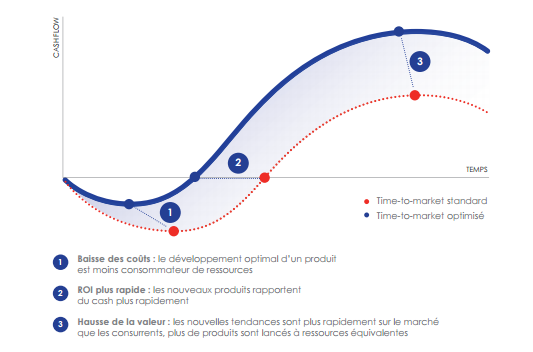
Time-to-market refers to the optimization of the time it takes to bring a product to market—that is, the time between a product’s design and its launch.
Effectively managing a company’s go-to-market schedule—its time-to-market—is often a challenge. Every manufacturer has experienced rushed product development to meet the demands of a trade show or seasonal sales. And there isn’t a single R&D manager who hasn’t been through heated meetings with their sales counterpart. Indeed, today’s products meet yesterday’s needs, and tomorrow’s products arrive the day after tomorrow.
However, the consequences of poor time-to-market management are significant.
For manufacturers constrained by industry trade shows or seasonal markets, the forced acceleration of their product launches inevitably results in compromised costs or performance. Certain features are left out. Negotiations with suppliers are bypassed, and existing technical solutions are adopted without optimization.
As for those who prefer to prioritize profit margins and product performance at the expense of timelines, delaying a launch date increases development costs. It allows competitors to gain a foothold and increases the risk of a disconnect between the product and evolving customer needs.
Conversely, optimizing time-to-market by accelerating product launches helps reduce one-time costs. It also enables companies to achieve a faster return on investment for their projects and to respond more quickly to market changes.
So, how can a company implement a strategy to accelerate its products’ time-to-market? What are the key factors and challenges involved?
Some of our clients go even further by designing modular product lines. The goal is to make an initial investment in order to launch more products more quickly over the long term, while keeping both recurring and non-recurring costs under control.
Experience shows that launching more projects does not lead to more products on the market, but rather to the opposite effect.
The causes are known:
For some people, the effects are visible:
And less visible to others:
The role of the executive committee is therefore to define this roadmap. This is done based on economic and strategic challenges, the competitive landscape, and an understanding of the company’s resources.
The main challenge will be to break down the glass walls between different departments—between sales and R&D, between R&D and production, and between procurement and other departments. In every company—even the most prestigious ones—there are shortcomings at the interfaces between business functions. For example, customer needs that are insufficiently or incorrectly communicated, industrialization that is only considered at the very end of a project, procurement that is integrated too late in the definition of technical solutions, and many others.
In addition, some organizations impose a highly standardized process consisting of phases and “gates” or milestones. For example, they require a single formal approval to launch the entire tooling process. These include Design Reviews, GO Tooling, and other major approval processes. It is often more effective to adopt a more adaptive approach, with approvals that are tailored to actual needs and more pragmatic in nature.
Rebuilding a process in which everyone is involved at the right time, information flows smoothly, and discrepancies are addressed as soon as possible requires everyone to reevaluate their approach. Behaviors and ways of working are sometimes deeply ingrained, and sharing information can undermine certain long-standing fiefdoms.
As we’ve seen previously, optimizing development processes leads to greater and earlier involvement of business units in R&D, which generally drives projects. Managing more employees more effectively requires practical tools and methods. The time spent on project management must remain limited so that efforts can be focused on value-added tasks. Best practices involve using visual management tools in conjunction with short but frequent meetings with the entire team—the well-known stand-up meetings derived from startup practices.
However, the organization and facilitation of these meetings must be carefully tailored to the company’s profile and that of the project manager. One could envision a highly directive system, but also a participatory approach, where the facilitator rotates with each session. Another key consideration is managing employees’ workload levels: it is well known that efficiency drops sharply when workload exceeds 80%. Moving away from a culture of overloading design office team members sometimes requires a structural change.
Manufacturers who build their product lines around a modular design exceed even the most ambitious time-to-market goals of their counterparts who use traditional systems.
Modular design involves breaking products down by function and then designing modules—or technology building blocks—for each function that will enable the entire product line to meet performance requirements.
The goal for manufacturers is to be able to launch more and more variants on the market by changing one or another of the modules, rather than starting from scratch.
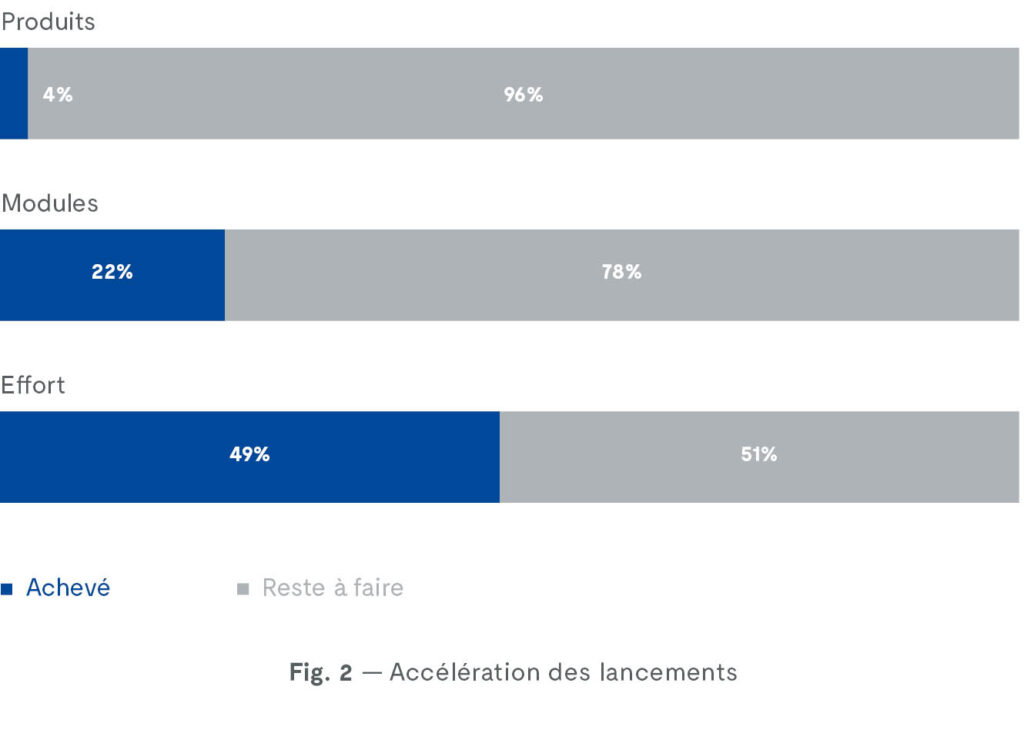
We saw an example of this with one of our clients, who designs and manufactures compressors for marine and industrial applications. Their goal is to launch 100 different variants over the next 10 years, even though their usual pace is one to two products per year!
We therefore defined, for each function (pistons, cylinders, engine, crankcase, etc.), the variety needed to cover the entire product line and the optimal technical solutions. We evaluated the costs and developed a development schedule. The conclusion was that 81 basic modules could be used to design all 100 products, whereas previously each product consisted of 10 unique functions.
Our client then developed the modules needed for the first products. As a result, after two years of development, the first four compressors were launched on the market. However, subsequent models will be launched at an accelerated pace, since some of the modules already exist.
Figure 2 below shows that while 4% of the products have been designed, 22% of the modules already exist, and nearly half of the required R&D effort has been completed.